Ecosystem consequences of mosaic hybrid zones
SUMMARY
In many landscapes, closely related plant species grow side-by-side and naturally form hybrids. We showed that these “mosaic hybrid zones” have important ecosystem consequences. By examining three important groups—rabbitbrush, big sagebrush, and globemallows—we found that hybrids often thrive in environmental conditions intermediate to those preferred by their parents. Moreover, we show that hybrids expand each group’s total geographic range—sometimes by hundreds of thousands of square kilometers—and may become even more important as the climate warms. Because hybrids can help connect fragmented habitats, they may offer new opportunities for land restoration. Our research suggests that carefully using hybrid plant materials could improve the success and resilience of restoration efforts in a rapidly changing world.
RESEARCH ARTICLE
Suturing fragmented landscapes: Mosaic hybrid zones in plants may facilitate ecosystem resiliency
Massatti R., Faske T.M., Barnes I.M., Leger E.A., Parchman T.L., Richardson B.A., & Knowles L.L. (2025) Proceedings of the National Academy of Sciences, e2410941122, https://doi.org/10.1073/pnas.2410941122
Significance
Mosaic hybrid zones offer opportunities for closely related taxa to occupy a larger environmental niche, which in topographically and environmentally heterogeneous regions may mean a larger, less fragmented geographic distribution. We quantify the ecological impact of mosaicism in three study systems important to restoration and landscape management across western North America by predicting the distributions of parents and hybrids across present and future environments. Land disturbance and climate change reinforce the necessity of developing strategies to create resilient plant communities, and hybrids that suture together parental distributions by occupying intermediate environmental space may present novel management opportunities by integrating speciation science with conservation practice.
Abstract
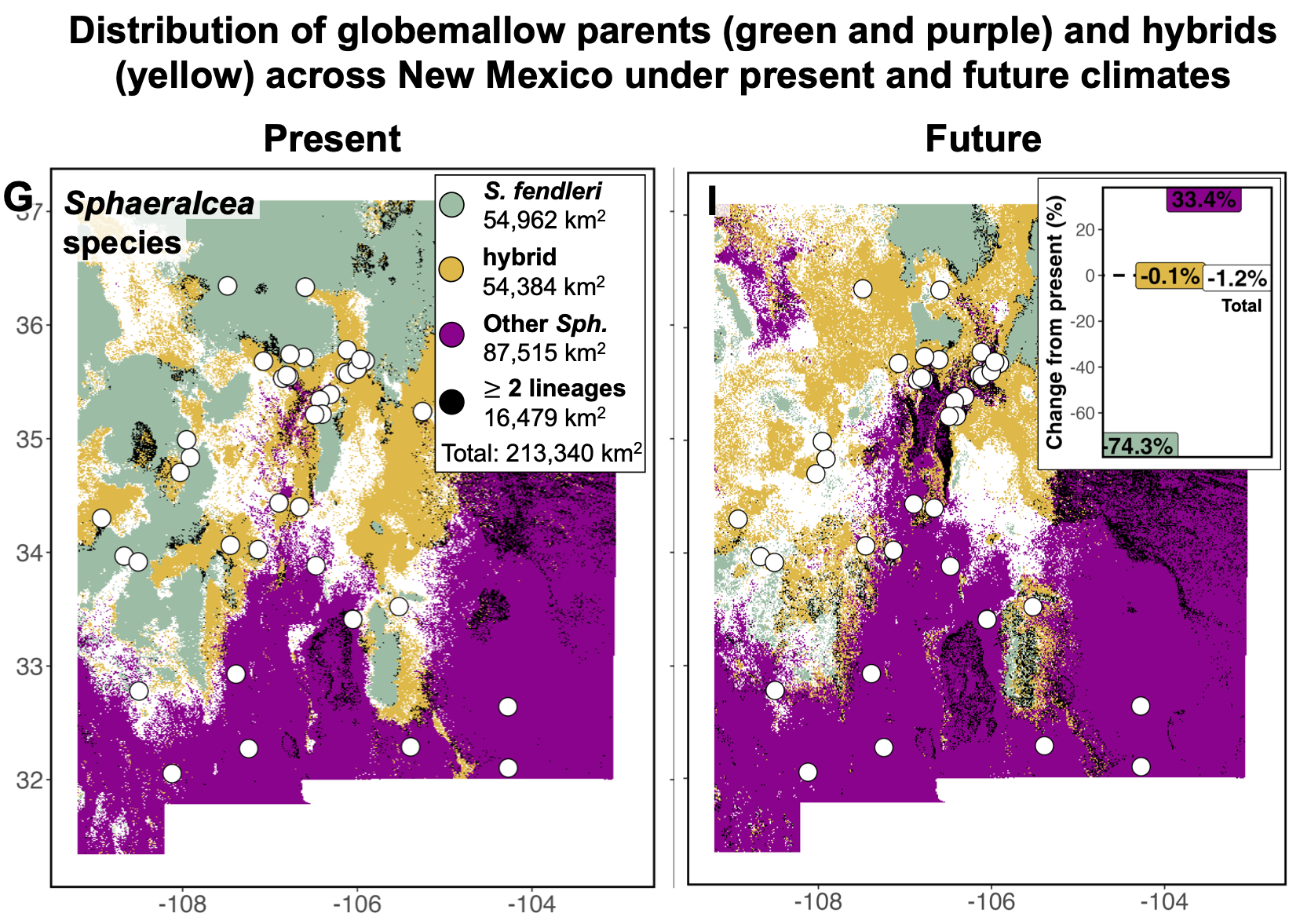
Many widespread plant taxa of western North America have diversified into phenotypically and genetically divergent lineages due to complex biogeographic histories across heterogeneous landscapes. Mosaic hybrid zones can form when geographically co-occurring, yet environmentally distinct, lineages cross-pollinate and form hybrids that occupy unique environmental niches absent of a geographic cline. This expands the total environmental space across which parental and hybrid individuals grow, resulting in larger, less fragmented geographic distributions. Here, we highlight hybridization mosaics across three study systems containing taxa critical to widespread plant communities in western North America: Ericameria nauseosa, Artemisia tridentata, and Sphaeralcea fendleri. The systems contain diverged taxa that co-occur across the landscape and hybridize readily. Hybridization among taxa has facilitated niche expansion into intermediate environments consistent with unique combinations of adaptive genetic variation, creating more continuity within each study system—study systems occupy ~820 to 270,000 km2 more geographic area by virtue of hybridization. Furthermore, hybrids are predicted to play important roles in future climates, as they may occupy 8 to 475% larger distributions compared to present. Convergent patterns signal mosaic hybridization as an underappreciated mechanism with broad ecological and evolutionary ramifications. Leveraging mosaic hybridization may assist the creation of restoration management plans that aim to mitigate the deleterious effects of habitat fragmentation on ecosystems in the context of climate change.