Rethinking seed transfer zones
SUMMARY
Restoring dryland ecosystems is challenging, especially when plants must survive hotter, drier, and less predictable conditions. Many restoration tools assume that seeds taken from climates similar to a project site will perform best. This study put that idea to the test by growing three native plant species from dozens of wild populations in a shared garden. The results showed that no single environmental factor—climate, soil, or location—explains plant survival on its own. Each species responded differently to temperature, rainfall patterns, soil texture, and even how far the seed had been moved. During years of extreme heat and drought, only one species benefited from being sourced from similarly harsh climates. The research suggests that relying on one “best-matched” seed source may be risky, and using a mix of regionally appropriate sources could better support long-term restoration success.
RESEARCH ARTICLE
Rethinking seed selection based on climate matching during restoration: geographic, soil, and climate variation help explain species-specific mortality patterns
Roybal C.M., Samuel E.M., Mitchell R.M., Winkler D.E., Massatti R.
Impact Statement
Restoration professionals often rely on science-based products to help with sourcing plant materials (frequently native seeds) to bolster restoration outcomes. Common products include seed transfer zones (geospatial polygons delimiting areas of environmental similarity) and web-based tools (that calculate environmental distances between seed sources and restoration sites). These tools are used under the assumption that restoration success is supported when distance between the seed source and restoration site is minimized. These assumptions are based on abundant research supporting the evolutionary process of local adaptation. Our analyses of mortality patterns across three plant species, each represented by 10-18 wildland seed sources collected from different environmental distances from an experimental garden, indicate that outcomes vary widely among species when strictly considering climate distance. Specifically, our results indicate 1) many facets of environmental variation influence species, including climate, soils, and unknown aspects correlated with geographic distance; 2) species respond to suites of environmental variation uniquely, impeding generalizations; 3) while a model can be constructed to explain mortality across species, mortality was positively correlated with climate distance for only one species; 4) for each species, the climatically closest population to the experimental garden did not have the lowest mortality – however, averaging mortality rates across seed sources with roughly similar, but not the same, climates always resulted in lower mortality. Further, we assessed patterns of mortality in the context of abnormally hot and dry weather at our experimental garden compared to average climates and demonstrate that predictive provenancing, or tailoring seed sources to current or future weather at a restoration site, worked in retrospect for only one species. Our results highlight a potential strategy for restoration in drylands: if multiple intraspecific, genetically appropriate, and climatically approximate seed sources are available, a regional admixture provenancing strategy may increase the probability that plants can establish and persist.
Abstract
Implicit in the construction of seed transfer zones (STZs) is the assumption that plant populations are adapted to their home climate and transferring native seed to different climatic areas risks maladaptation and poor plant performance. However, plants are adapted to many aspects of their environments that are often excluded in the construction of STZs. Here, we use models that include combinations of geographic distance, climate distance, and soil metrics, to predict plant mortality in an experimental garden for three species important to restoration in the southwestern United States (U.S.), including Bouteloua curtipendula, Heterotheca villosa, and Sporobolus cryptandrus. While climate distance performed better than geographic distance in predicting mortality, increasing climate distance was not consistently correlated with higher mortality, while geographic distance was. In fact, species responded uniquely to environmental gradients, indicating site-specific details beyond climate may provide more accurate predictions. Moreover, while seed sources originating from hotter, drier climates of one species, H. villosa had improved survival rates during abnormal hot and dry weather during the experiment, there was no consistent signal in B. curtipendula or S. cryptandrus. Our results indicate considering more diverse seeding strategies may be important to support successful restoration outcomes, especially when comprehensive, species-specific information is not available.
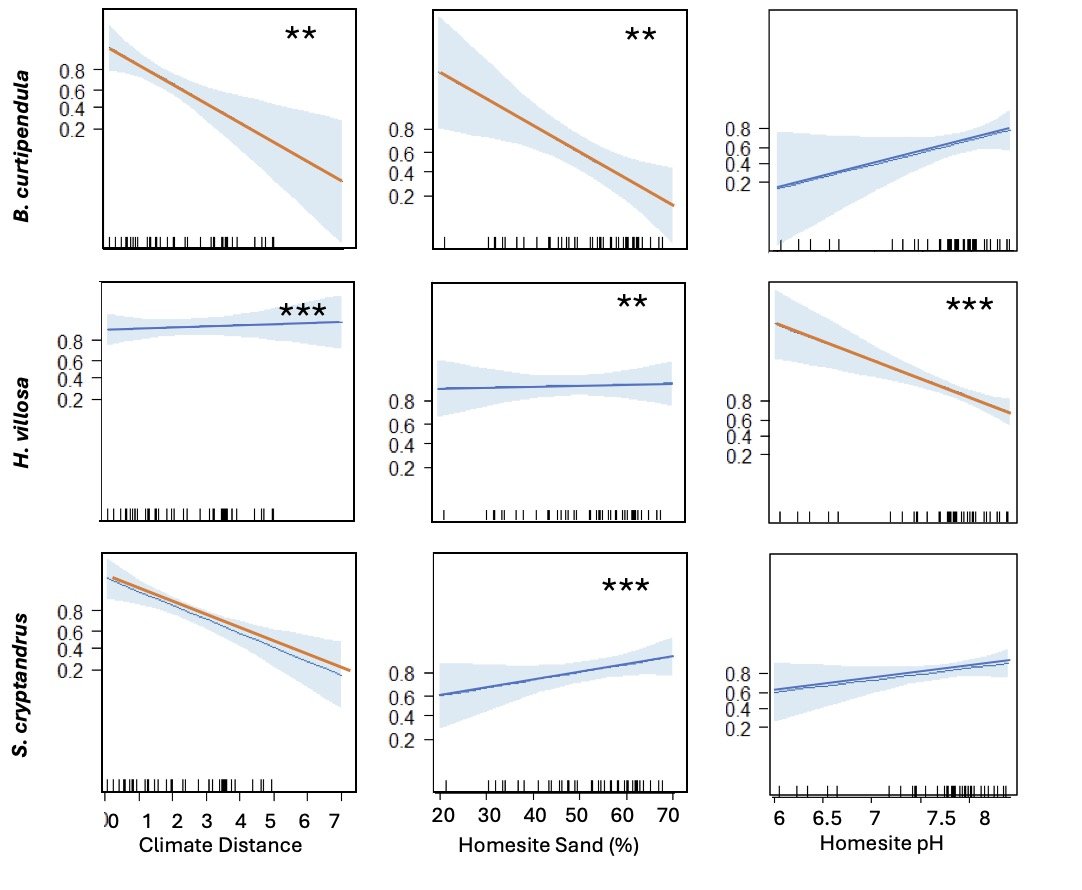
Estimated mortality effects based on the best predictive model, Proportion Dead ~ pH Species + Percent Sand Species + GeographicDistance + Climate Distance * Species. Species showed individualistic responses to climate distance between collection site and garden (first column), homesite percent sand (second column), and homesite pH (third column). Black stars indicate a significant effect, orange lines signify a negative relationship between the predictor and mortality, and blue lines a positive relationship between the predictor and mortality. Hash marks on the x-axis represent data points.